Naar inhoud

Winkelwagen

Je winkelwagen is leeg

Artikel: Brainfood recept: Zelfgemaakte ghee

Recepten

Brainfood recept: Zelfgemaakte ghee


Brainfood recept: Zelfgemaakte ghee


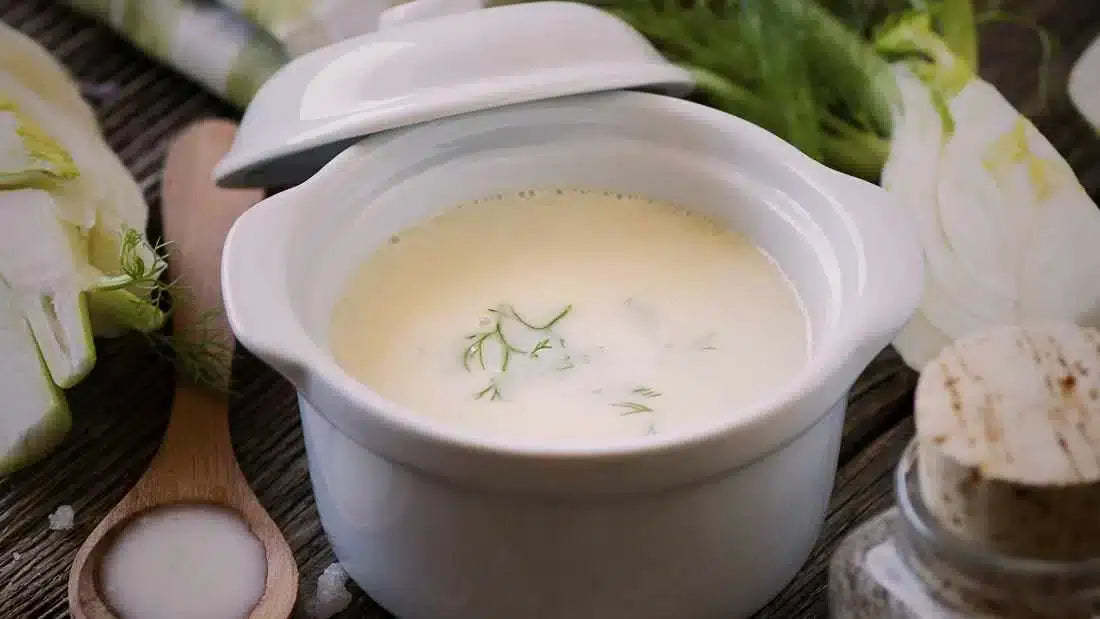
Ghee is een brainfood, het staat bekend om zijn rijke smaak en gezondheidsvoordelen.

Ghee is een geklaarde boter die vaak wordt gebruikt in de Ayurvedische keuken. Ghee is veelzijdig; kan worden gebruikt om te koken, bakken en braden. Het heeft een nootachtige smaak en kan ook gebruikt worden als smeersel.

Benodigdheden

  • een pakje roomboter (ongezouten, bij voorkeur biologische
  • pan met dikke bodem
  • lepel
  • kaasdoek of theedoek
  • potje voor de ghee

Recept

  1. Snijd de boter in kleine stukjes. Dit helpt het proces te versnellen.

  2. Doe de boterstukjes in een zware pan op laag tot middelhoog vuur.

  3. Laat de boter smelten en vervolgens zachtjes koken. Het zal beginnen te bruisen en schuimen.

  4. Terwijl de boter kookt, zal er schuim op het oppervlak verschijnen. Schep voorzichtig het schuim weg met een lepel

  5. Ga door met koken totdat er geen schuim meer. is.

  6. Leg een stukje kaasdoek of een schone theedoek in een zeef en plaats deze over een kom of pot.

  7. Giet de geklaarde boter door het kaasdoek om eventuele overgebleven melkdeeltjes te verwijderen. Dit resulteert in heldere ghee.

  8. Laat de ghee afkoelen tot kamertemperatuur. Giet het dan in een schone, luchtdichte pot.

    Nu heb je zelfgemaakte ghee om te gebruiken in je recepten. Ghee blijft buiten de koelkast goed, maar het kan ook in de koelkast worden bewaard voor een langere houdbaarheid.
Marlise Staal

Over de auteur

Ik ben Marlise Staal, oprichter van Mayura, en ik heb een passie voor Ayurveda en de manier waarop het meer balans, vitaliteit en welzijn kan brengen.
In Kerala, de oorsprong van de Ayurveda, heb ik mijn kennis de afgelopen jaren verdiept door trainingen en het werken met lokale artsen en traditionele kennisdragers.
Daarnaast werk ik samen met ayurvedisch specialist Dr. V.A. Venugopal uit Thrissur (India), en word ik in Nederland sinds 2016 begeleid en geïnspireerd door ayurvedisch arts Dr. Lita Dash (B.A.M.S.).

Bronnenlijst


1. https://www.nationalgeographic.nl/wetenschap/a64686966/brain-fog-hersenmist-long-covid

2. PMC – Focal neuropathologies in the brain of COVID-19-infected humans: inflammation, primary gliovascular failure and microglial dysfunction (2025): pmc.ncbi.nlm.nih.gov

https://pmc.ncbi.nlm.nih.gov/articles/PMC12375775/

3. PMC – Exploring SARS-CoV-2 impact on blood-brain barrier and its composition: A review: pmc.ncbi.nlm.nih.gov

4. ScienceDirect – Shared Mechanisms of Blood-Brain Barrier Dysfunction and Neuroinflammation in Coronavirus Disease 2019 and Alzheimer Disease (2025): sciencedirect.com

5. New England Journal of Medicine – Long Covid and Impaired Cognition — More Evidence and More Work to Do (2024): nejm.org

6. ScienceDirect – Neurocognitive trajectories in long COVID: Evidence from longitudinal analyses (2025): sciencedirect.com

7. Nature Scientific Reports – Omics-based analysis of mitochondrial dysfunction and BBB integrity in post-COVID-19 sequelae (2024):


8. PMC – Cardiovascular autonomic dysfunction in "Long COVID": pathophysiology, heart rate variability, and inflammatory markers (2023): https://www.ncbi.nlm.nih.gov/pmc/articles/PMC10502909/

PMC – Prevalence of peripheral neuropathy and myopathy in patients post-COVID-19 infection (2022): https://pmc.ncbi.nlm.nih.gov/articles/PMC9538868/

9. PMC – Current update on the neurological manifestations of long COVID: more questions than answers (2025): https://www.ncbi.nlm.nih.gov/pmc/articles/PMC11755773/

10.PMC – Long COVID and neuropsychiatric manifestations (2022): https://www.ncbi.nlm.nih.gov/pmc/articles/PMC9019760/

11. PMC – Severe Neurocognitive Manifestations in Healthy Young Individuals With COVID-19: A Case Series (2025): https://www.ncbi.nlm.nih.gov/pmc/articles/PMC12715132/

12.MDPI – The Significance of Low Magnesium Levels in COVID-19 Patients (2023): https://www.mdpi.com/1648-9144/59/2/279

13. PMC – Long COVID and long chain fatty acids: Psychoneuroimmunity implication of omega-3 LCFAs in delayed consequences of COVID-19 (2022): https://pmc.ncbi.nlm.nih.gov/articles/PMC8977215/


14. Thuisarts – Ik kan minder goed denken of onthouden na corona (laatst gewijzigd 30 juli 2024): https://www.thuisarts.nl/lang-klachten-na-corona/ik-kan-minder-goed-denken-of-onthouden-na-corona

15. PMC – Dietary Recommendations for Post-COVID-19 Syndrome (2022): https://pmc.ncbi.nlm.nih.gov/articles/PMC8954128/

16. PMC – Refined carbohydrates and the overfat pandemic: implications for brain health and public health policy (2025): https://pmc.ncbi.nlm.nih.gov/articles/PMC12602494/

17. PMC – Cognitive and affective psychoeducation for Long COVID: a randomized controlled trial (2025): https://www.ncbi.nlm.nih.gov/pmc/articles/PMC12631555/

18. PMC – Intervention modalities for brain fog caused by long-COVID: systematic review of the literature (2024): https://www.ncbi.nlm.nih.gov/pmc/articles/PMC11176231/

19. ScienceDirect – Ayurveda and Brain Health (2020): https://www.sciencedirect.com/science/article/abs/pii/B9780128205938000306

20. PMC – Nootropic herbs (Medhya Rasayana) in Ayurveda: An update (2012): https://pmc.ncbi.nlm.nih.gov/articles/PMC3459457/

21. PMC – Investigating the Neuroprotective and Cognitive-Enhancing Effects of Bacopa monnieri: A Systematic Review (2024): https://pmc.ncbi.nlm.nih.gov/articles/PMC11047749/

22. PMC – Ashwagandha as an Adaptogenic Herb: A Comprehensive Review of Immunological and Neurological Effects (2025): https://www.ncbi.nlm.nih.gov/pmc/articles/PMC12680924/

Veelgestelde vragen over hersenmist en het zenuwstelsel na COVID-19

Order